Level 1 · Lesson 2
The table: positions, blinds & the button
A poker hand isn't a free-for-all — there's a fixed order of play, and where you sit in it changes everything. After this lesson, you'll read the table like a regular — the button, the blinds, who acts when — so you never look like the new player in the seat.
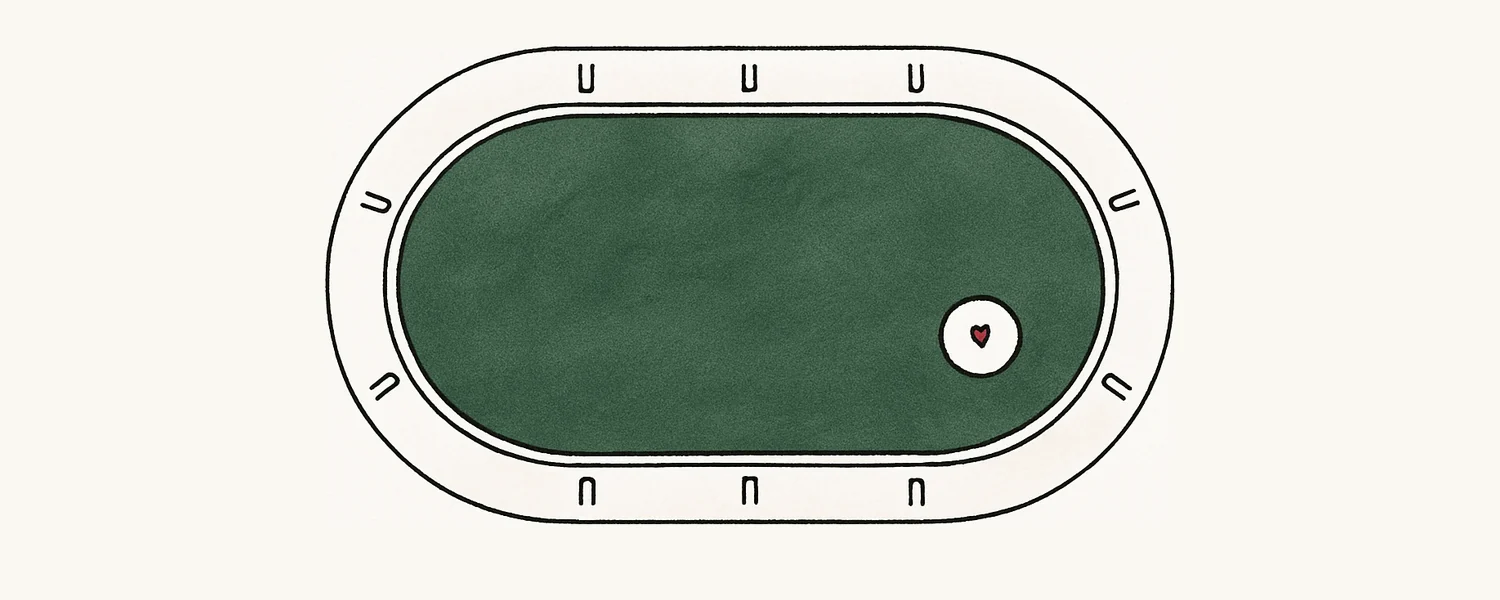
How many players do you need?
Texas Hold'em works with anywhere from 2 to 10 players at one table. Two players is called heads-up; a packed table of nine or ten is a full ring game; six players is the popular 6-max. You only need two people to play a legal hand — everything below scales between those extremes.
The dealer button
One player is the nominal dealer each hand, marked by a disc called the button. In a casino a professional croupier deals the cards, but the button still marks whose deal it is, because position is decided relative to it. After every hand the button moves one seat clockwise, so the advantage rotates fairly around the table.
The blinds
To make sure there's always something to play for, the two players to the left of the button post forced bets called blinds before any cards are dealt:
- The small blind sits immediately left of the button and posts the smaller forced bet.
- The big blind sits to the small blind's left and posts the full minimum bet — usually double the small blind.
The blinds set the stakes of the game. A "$1/$2" table means a $1 small blind and a $2 big blind. Because they've already put money in, the blinds act at the end of the preflop round — the big blind is last to act, closing the betting — a small consolation for being forced to bet blind.
Position groups
Seats are grouped by how early or late they act after the flop:
- Early positionThe first seats to act (incl. "under the gun", left of the big blind). Hardest spot — act with the least information.
- Middle positionA few players still to act behind you. Moderate caution.
- Late positionThe "cutoff" and the button. You act last — the most powerful seats.
- The blindsAct at the end preflop (the big blind closes it), but first on every later street. A tricky place to play from.
Check yourself — no peeking
Answer each from memory. Retrieving the answer is what builds lasting recall.